
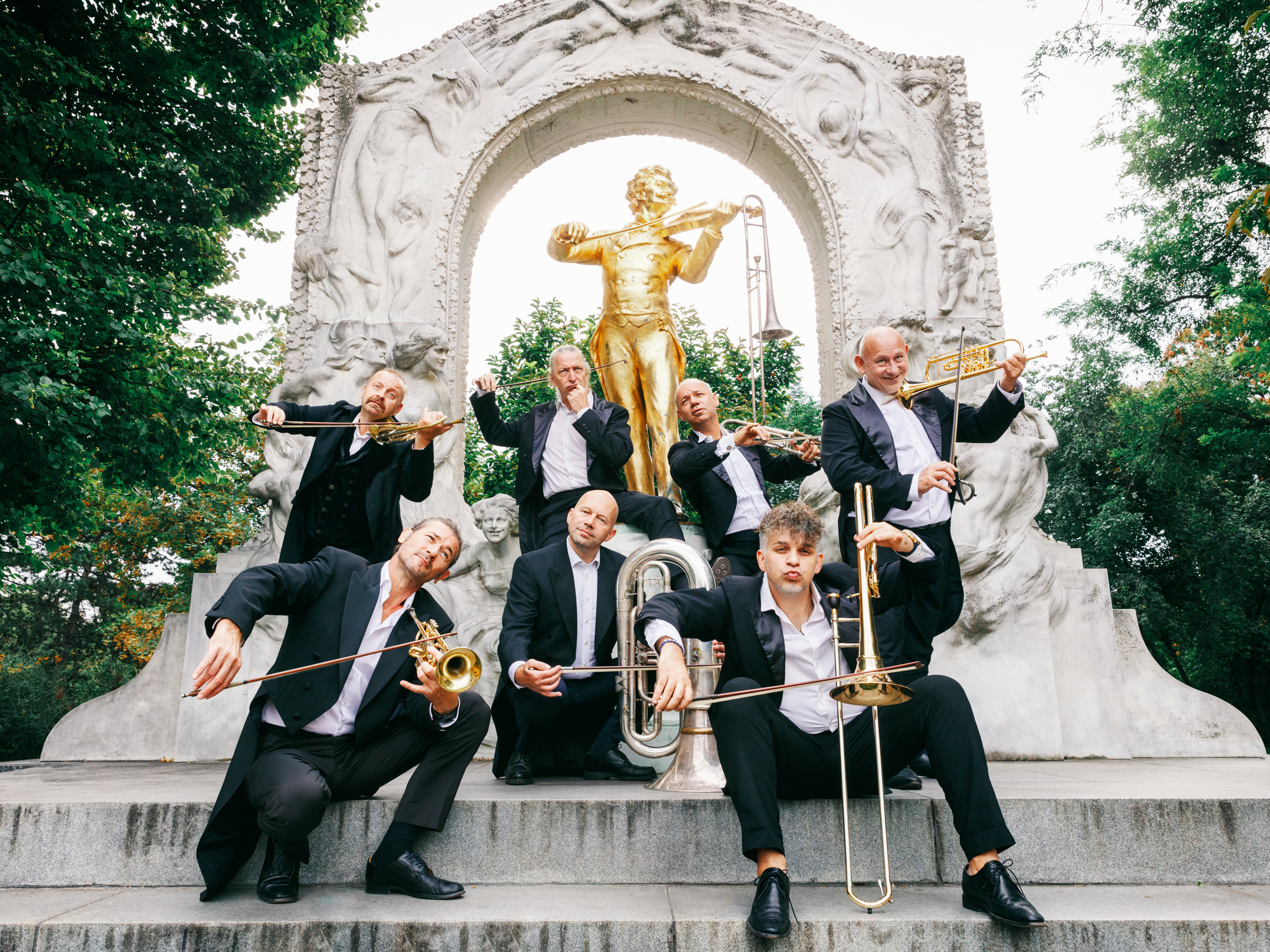
Mnozil Brass - STRAU$$
In “Strau$$,” Mnozil Brass takes a closer look at the “Waltz King.” With virtuoso brass music, wit, and musical surprises, they take the audience on a journey from Strauss to Sinatra, Shostakovich, and Queen.
27.05.2027 |
19:30
Opening hours
Thursday, May 27, 2027, at 7:30 p.m.<br>Stadtcasino<br>Konzertgasse 1<br>4051 Basel<br>Doors open: 6:30 p.m.<br>Admission: 7:00 p.m.
Price information
Prices in CHF
Cat. 1 Cat. 2 Cat. 3 RS Cat. 1 RS Cat. 3
Full price 95.00 85.00 75.00 95.00 75.00
Schoolchildren and students (under 26) Cat. 1 - 85.50 Cat. 2 - 76.50 Cat. 3 - 67.50
Event Links
Event details
Strau$$ – A Little Dance Between Two Chairs
The fact that the waltz-soaked “Duidu, Duidu” and its laid-back counterpart “Dudidubidu” are actually just a stone’s throw apart—not much more than “a warm embracing dance away”—has been clear to the masters of Mnozil Brass for ages. For more than thirty years now, these seven powerhouse musicians have been gliding back and forth with the utmost ease—and their sparkling brass instruments—between Johann Strauss and Frank Sinatra, between Shostakovich and Prince, or, with particular passion, from Schubert over to their kindred spirits in Queen. They care just as little about the solemn grandeur of one side as they do about the supposed banality of the other. But Strauss—whom Brahms, Wagner, and Verdi, as well as the craftsmen and the girls from the suburbs (and even a Gershwin) ardently adored—was the forefather of this nonchalant straddling of genres. Strauss was the first to churn out hits by the meter; he hired an arranger to work faster and realized that, together with his brothers, he could reproduce his sound worldwide. He was the first to blur the lines between art and popular music and, as the “Waltz King,” became a mass phenomenon—the cash registers never rang sweeter. In *Strau$$*, Mnozil Brass now reveals absolutely everything about Strau$$. Even the very last detail.
In the end, nothing remains but the naked truth.
Note: This text was translated by machine translation software and not by a human translator. It may contain translation errors.
organizer
Interfinity
office@interfinity.ch
Venue
Stadtcasino Basel
Konzertgasse 1
4051 Basel


All rights reserved.